Every URNAM piece begins as flat, undecorated cloth. What happens to it after that, in the hands of the atelier, is the actual work. Eight techniques do most of that work: hand-pleating, smocking, hand-frayed edges, hand embroidery in its several forms (cross stitch, bullion stitch, kantha, aari, french knots), sequin work, cutwork, appliqué, and hand felting. Each one changes the surface of the fabric in a different way, and each one takes a different kind of patience. Here is what each technique actually is, where it comes from, and what it takes to make.
In this article
- Hand-pleating
- Smocking
- Hand-frayed edges
- Hand embroidery: cross stitch, bullion stitch, kantha, aari, french knots
- Sequin work
- Cutwork
- Appliqué
- Hand felting
- FAQ
What is hand-pleating, and why does it take longer than it looks?
Pleating sounds mechanical. Done by hand, it is not. Each fold is measured, pressed, and set individually, and a single panel can carry dozens of pleats that all need to sit at the same depth and angle for the finished piece to fall correctly. A machine pleater repeats one fold instantly across a length of fabric. A hand pleater repeats it once, checks it, and moves to the next. The Soft Illusion Skirt uses this approach across multiple panels, each hand-pleated to build the texture and volume of the finished silhouette, rather than pressed flat in one pass.

A balloon-fit linen skirt, hand-pleated panel by panel, finished with nature-inspired brooches.
What is smocking, and where does it come from?
Smocking gathers fabric into a controlled, elastic texture, traditionally to let a garment fit closely without buttons or elastic thread. The technique developed in England and takes its name from the smock, a labourer's work shirt that needed to move with the body while staying close to it. Hand smocking begins with a grid of evenly spaced dots marked on the reverse of the fabric. The fabric is gathered along those dots with temporary stitches, then a permanent embroidery stitch, cable, honeycomb, or wave among others, locks the gathers in place and gives the surface its texture. Done by hand, a smocked panel usually reduces to about a third of its original width, which is why it takes considerably more fabric than the finished area suggests.
What are hand-frayed edges, and why leave them unfinished?
A frayed edge is a finished decision, not an accident. The atelier removes the weft or warp threads along a hem or panel edge by hand, one at a time, until what is left is a soft, irregular fringe that a cut or overlocked edge could never produce. It takes patience to do evenly, since pulling the wrong thread or rushing the count changes the density of the fray. The result reads as quiet and unforced, closer to how a natural fibre wears in over years than to a manufactured finish.
What is hand embroidery, and how do cross stitch, bullion stitch, kantha, and aari differ?
Hand embroidery is not one technique but a family of them, and the atelier draws on several. Each has its own history and its own visual signature.
Cross stitch is built from two crossing diagonal stitches worked in a grid, giving a precise, textured, slightly pixelated look. It is one of the oldest and most widespread embroidery forms in the world, valued for its geometric clarity.
Bullion stitch, also called a bullion knot, wraps thread around the needle several times before the needle is pulled through, forming a raised, coiled stitch with a three-dimensional, almost sculptural quality. It is slow and exacting work, since too tight a wrap and the coil will not sit, too loose and it collapses. Bullion knots are traditionally used to form flowers, buds, and textured borders.
Kantha is a running-stitch embroidery tradition from Bengal, dating back centuries, originally developed by women layering and restitching worn cotton saris into quilts and covers. Its defining quality is the rippled, slightly uneven texture that a simple running stitch creates when repeated across a surface, a texture no machine reproduces convincingly.
Aari uses a hooked needle, worked from a frame, to form a continuous chain stitch at speed while holding intricate detail. It originated in Gujarat, first used by leatherworkers on footwear, before moving into courtly textiles during the Mughal period.
French knots are small, raised dots formed by wrapping the thread around the needle before anchoring it back into the fabric, used singly for texture or clustered densely to suggest shading, fill, or a soft, woolly surface.

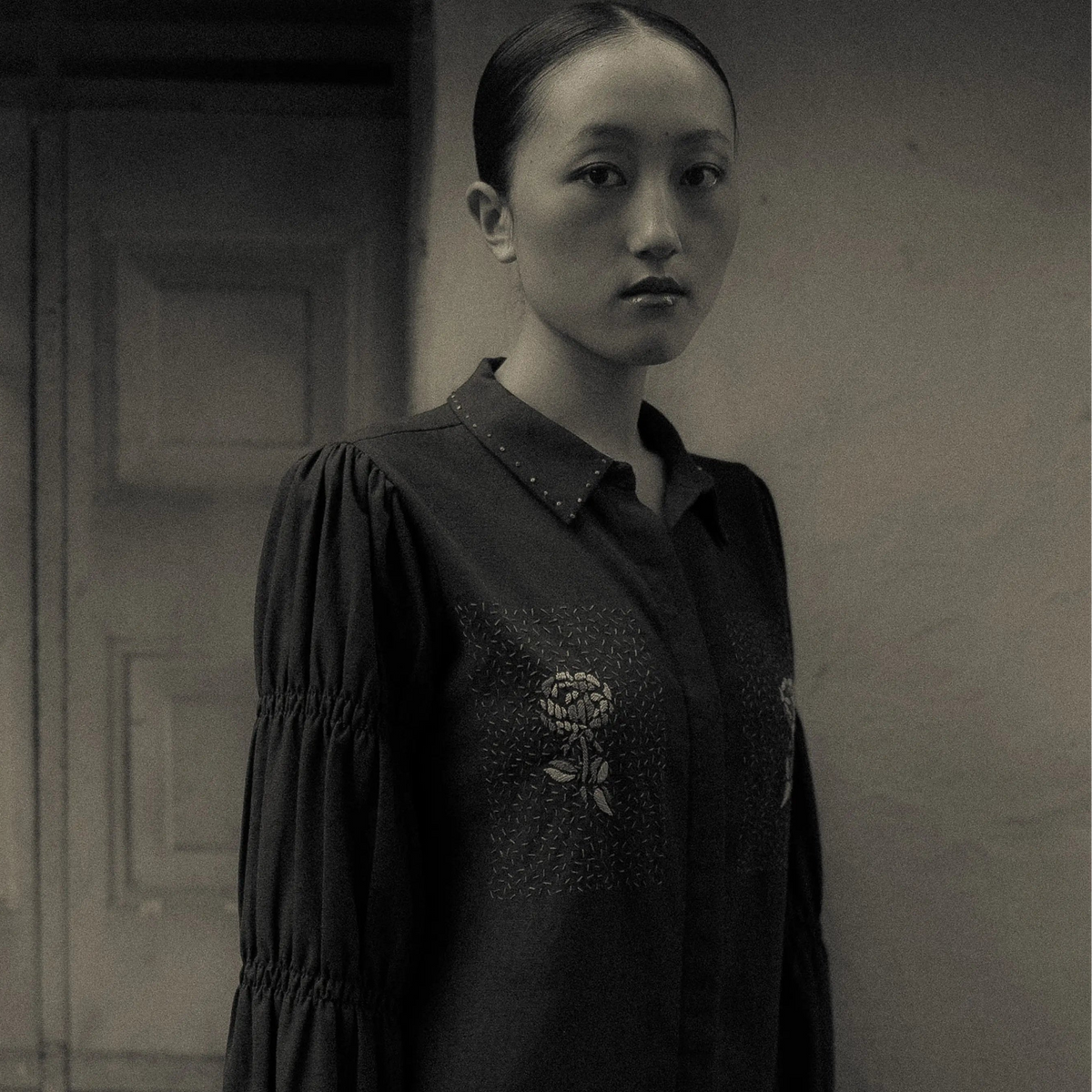
A restrained shirt dress in airy linen, finished with hand embroidery worked into a quiet surface.
What is sequin work, and how is it different from mass-produced embellishment?
Hand-applied sequin work anchors each sequin, or small cluster, individually with a needle and thread, rather than running a continuous strip of pre-strung sequins across a surface. This means density, placement, and direction can vary deliberately across a motif, catching light unevenly rather than in one flat sheet. It is slower than machine or strip application, but it is also the only way to place sequins to follow a specific shape rather than a straight line.
What is cutwork, and how old is the technique?
Cutwork removes sections of the fabric entirely, then reinforces and finishes the resulting opening with embroidery or needle lace so the edges do not fray. It is considered a precursor to lace, and different regions have developed their own versions of it for centuries, from Renaissance Italy to jaali work in India. The amount of fabric removed can range from a few small cut motifs to dense, lace-like fields. Hand cutwork requires the edges of every opening to be stitched closed before the surrounding fabric is cut away, so the sequence matters as much as the stitching itself.
What is appliqué, and what does it add that embroidery alone cannot?
Appliqué builds a motif by cutting a shape from one fabric and stitching it onto a base fabric, rather than forming the shape entirely in thread. This gives it a dimensional, layered quality that flat embroidery does not have, since the applied fabric sits slightly raised off the surface beneath it. It is usually finished with a fine hand stitch along the edge to secure it and prevent fraying, and it pairs naturally with embroidery, which is often added on top of or around the applied shape to anchor it further.
What is hand felting, and how does it turn loose fibre into fabric?
Felting compresses loose wool fibres together using friction, moisture, and pressure until they lock into a single, dense, non-woven surface, no weaving or knitting involved. Done by hand, the fibres are worked gradually, layer over layer, until the felt reaches the density and thickness the design calls for. The result is warm, textural, and slightly irregular in a way that machine-felted fabric, pressed uniformly under industrial rollers, does not replicate.

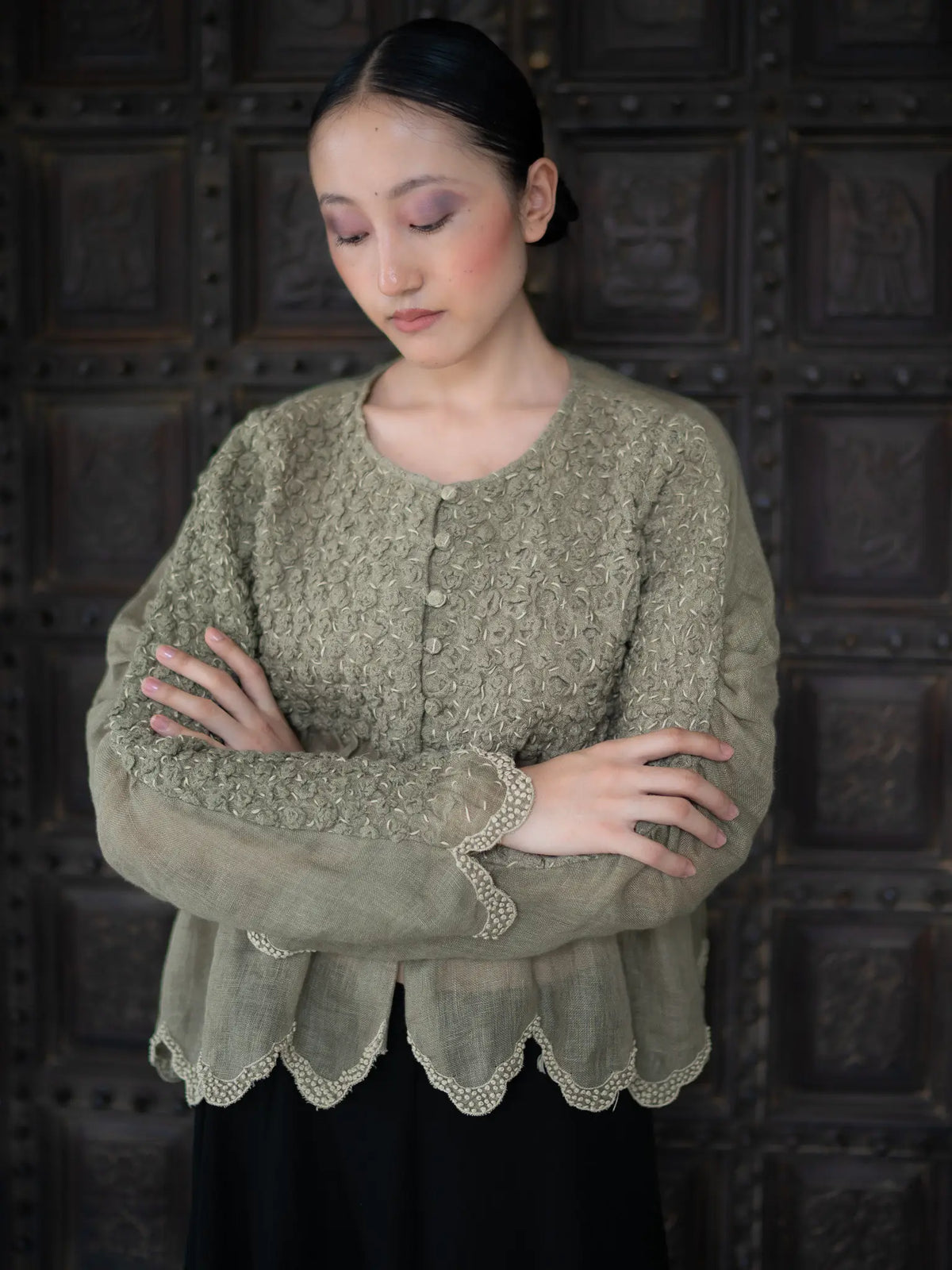
A quilted linen vest, elevated with hand embroidery worked in close, considered tones.
Frequently asked questions
How long does one hand-embroidered technique take to complete on a single garment?
It depends on the density and the technique. A restrained motif in bullion knots or french knots can take several hours. A denser field of kantha or aari work, or a fully hand-pleated panel, can take days. This is why made-to-order pieces built around these techniques carry a production timeline rather than shipping immediately.
Can these techniques be combined on a single garment?
Yes, and they often are. Appliqué is frequently paired with embroidery to anchor the applied shape. Cutwork is often finished with the same hand stitches used in embroidery. Hand-pleated panels can carry embroidery or sequin work on top of the pleating. The atelier treats these as a vocabulary, not a single fixed method.
Why use hand techniques instead of machine equivalents that look similar?
Machine versions of pleating, embroidery, and felting are faster and more uniform, which suits some uses well. Hand techniques carry irregularity that comes from a person making thousands of small decisions across a single piece, which gives the surface a texture and depth that a repeated, programmed pattern does not have.
Do hand-embellished garments need different care than plain fabric?
Generally yes. Hand wash or dry clean where advised, keep embellished surfaces away from friction, and avoid direct sun when drying, since prolonged exposure can fade both fabric and thread. Store pleated or smocked pieces folded gently rather than crushed to help the structure hold.
Related reading: How to Spot Real Hand Embroidery on Contemporary Wear
See the techniques up close
Every URNAM piece is made by hand, on natural, breathable fabric, made to your measurements.
Explore the collection →