
Turn the garment inside out and look at the back. That single check tells you more than the price tag ever will. Hand embroidery leaves a quiet trail, a path of knots and thread ends that a person left behind. Machine embroidery leaves a flat, uniform layer, often backed by stabilizer. Beyond that, look for irregular stitch length, thread that catches light unevenly, and small asymmetries that repeat but never quite match. Six checks, and you will not be fooled again.
In this article
- What does the back of the fabric tell you?
- Are the stitches identical or alive?
- How does the thread catch the light?
- How many shades are actually there?
- Does the price match the hours it claims?
- What does the timeline tell you?
- Quick comparison
- FAQ
What does the back of the fabric tell you?
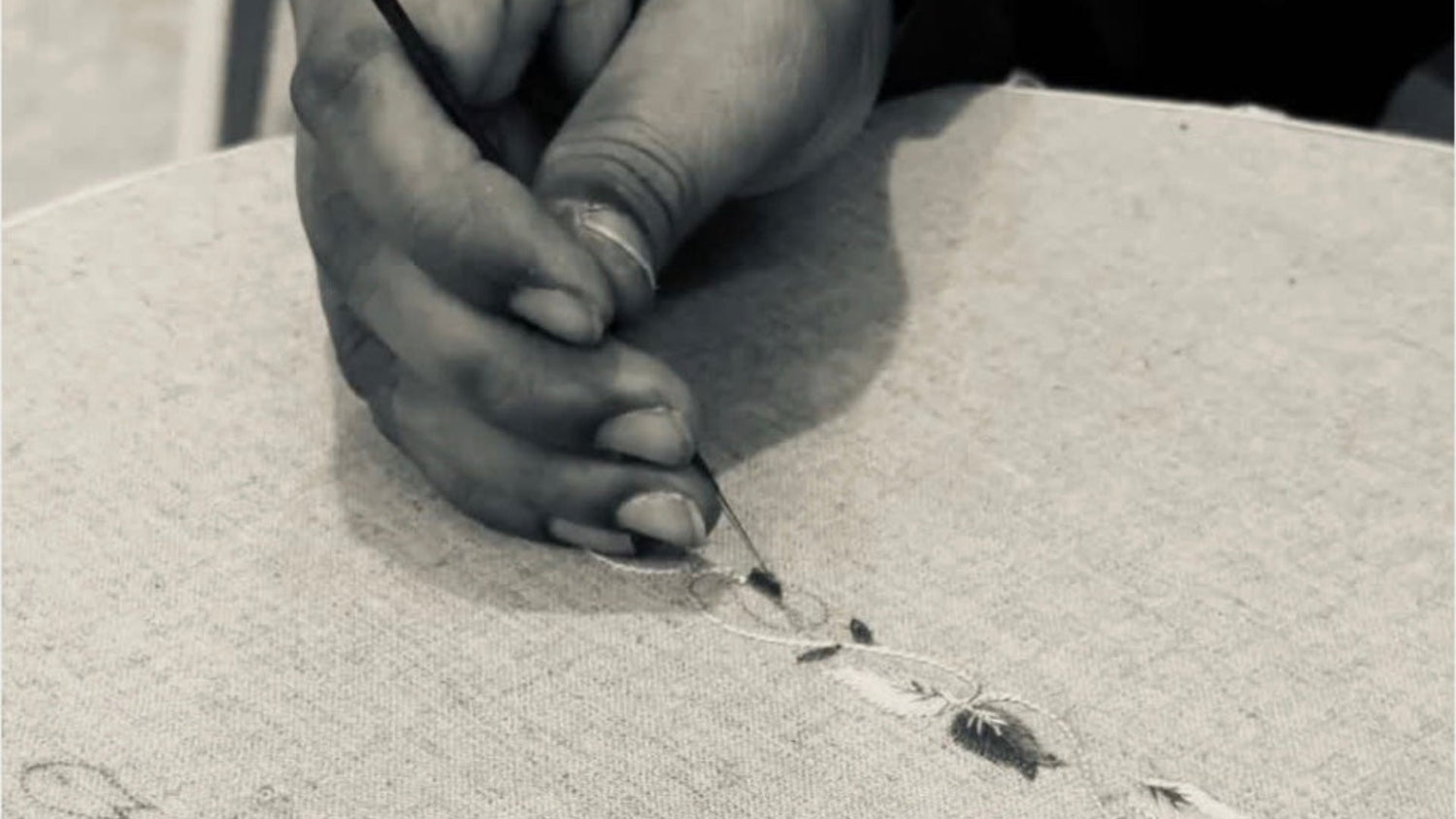
This is the fastest check, and the one almost nobody thinks to do before buying. Flip the garment over. Machine embroidery is built on a stabilizer, a backing layer that gets left in place or torn away, and what remains is a dense, mechanical run of carried thread, often uneven and closed off in one direction. Hand embroidery has no stabilizer to hide behind. The back should look considered even where it is not decorative, small knots here, a visible path of the needle there, evidence of a hand that was paying attention the entire time.

Are the stitches identical or alive?
Machines are built for consistency. Every stitch in a satin stitch fill will be the same length, the same tension, the same angle, because that is what a program does well. A hand embroiderer works the opposite way. She adjusts the angle of each stitch to follow the shape she is filling, the way a petal curves or a leaf vein bends, so no two stitches are ever perfectly alike even when they were meant to match. That variation is not a flaw. It is the signature.

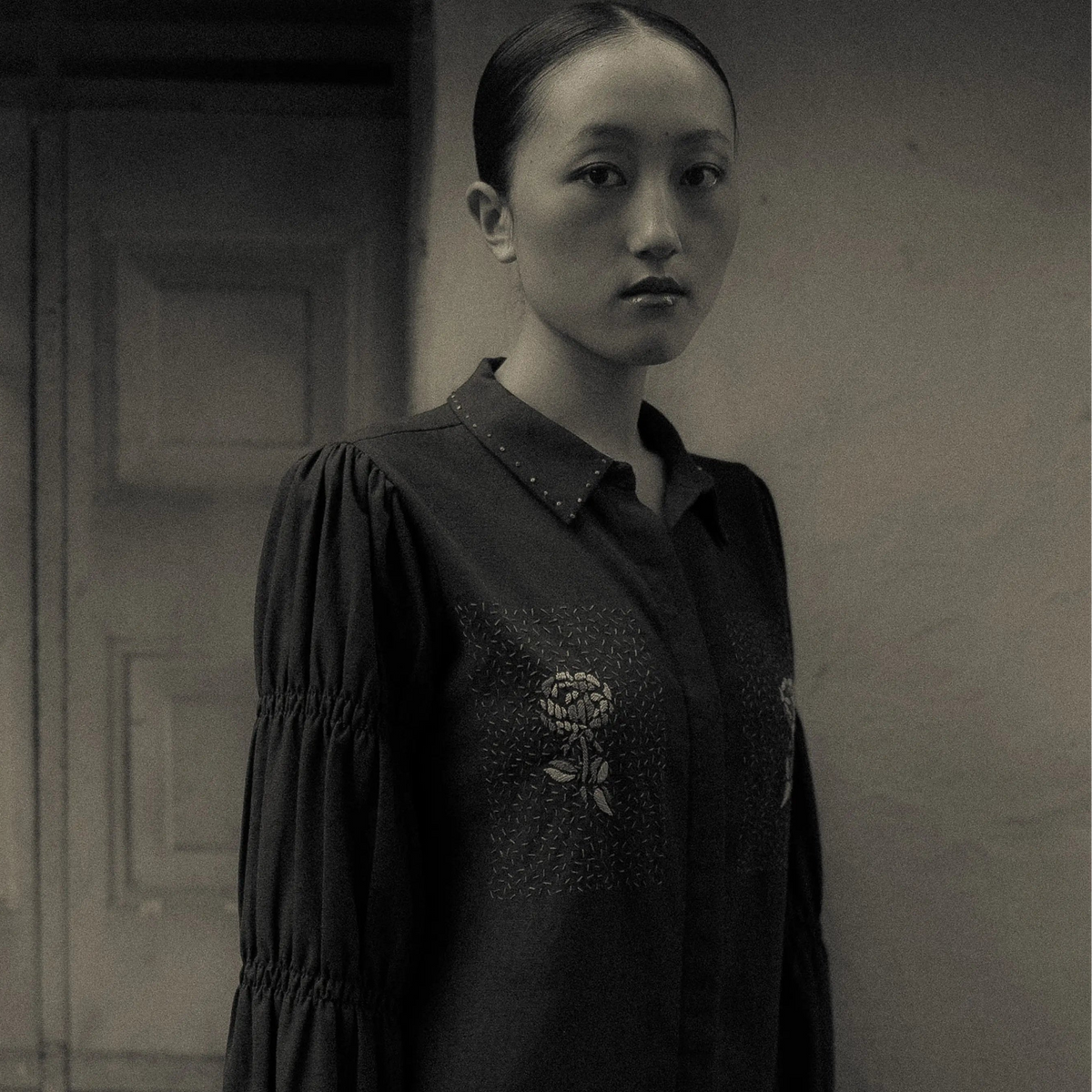
Airy linen, a wrap silhouette, hand embroidery worked into a quiet surface.
How does the thread catch the light?
Hold the garment under a lamp and tilt it. Natural fibers such as silk and fine cotton thread reflect light in several directions at once, because a hand embroiderer angles each stitch slightly differently to mimic how light falls on the real thing she is depicting, a petal, a vein, a fold. The result shifts as you move. Synthetic thread used in most machine work reflects light in one flat, uniform sheen, more plastic than fabric. If the shine does not change as you turn the garment, the thread probably did not change either.
How many shades are actually there?
Count the colors in a single motif. A machine changes thread color at a cost, in time and in complexity, so most machine embroidered pieces use somewhere between three and five shades per design, with sharp, deliberate transitions between them. A hand embroiderer can pick up a slightly different shade for every few stitches, so a single flower petal might carry a dozen close tones blending into one another the way a watercolor does. If the gradients look soft rather than stepped, that is a hand at work.

Breathable linen, elevated with hand embroidery worked in close, considered tones.
Does the price match the hours it claims?
A small, restrained motif of hand embroidery can still take several hours to finish. A denser surface can take days. That labor is the largest part of what you are paying for, more than the fabric itself. So treat an unusually low price on a piece described as hand embroidered as information, not luck. If a hand embroidered linen dress costs the same as a printed one from a mass retailer, one of those two claims is not true.
What does the timeline tell you?
This check happens before you even see the garment. Mass produced embroidery ships in days because a machine does not tire. Hand embroidery, especially on made-to-order pieces, takes weeks, because a person is doing the work at the pace a person works. If a brand promises a heavily hand embroidered piece will ship within 48 hours, ask how. The honest answer is usually that it will not be entirely by hand.
Hand embroidery vs machine embroidery: quick comparison
| What to check | Hand embroidery | Machine embroidery |
|---|---|---|
| Back of fabric | Neat, visible needle path, small knots | Dense, uniform, often stabilizer backed |
| Stitch length | Varies, follows the shape | Identical, repeatable |
| Thread and light | Shifts as you move it | Flat, uniform sheen |
| Color range per motif | Often 8 to 12+ blended tones | Usually 3 to 5, stepped |
| Production time | Days to weeks | Minutes to hours |

A restrained shirt dress in airy linen, finished with hand embroidery, not shouted, just there.
Frequently asked questions
Is hand embroidery always better than machine embroidery?
Not always, and it depends what you want. Machine embroidery is consistent, faster, and often more affordable, which suits pieces where uniformity matters. Hand embroidery costs more because a person's time and skill went into it, and it carries the small variation that makes a piece feel made rather than manufactured.
Can machine embroidery look convincing enough to fool most buyers?
Yes, especially in a photograph or under poor light. This is exactly why the checks in this piece rely on touch and close inspection rather than appearance alone. The back of the fabric is the hardest thing for a machine to disguise.
Why does hand embroidery cost so much more?
Mostly labor. A single motif can take hours, a denser surface can take days, and the artisan's skill was built over years, not learned overnight. You are paying for the time and the training, not only the materials.
Does hand embroidered clothing need special care?
Generally yes. Hand wash or dry clean where advised, avoid direct sun when drying, and keep the embroidered surface away from friction where possible. Natural fibers like the linen and cotton used in hand embroidered pieces also breathe better and age more gracefully with proper care.
Is made-to-order hand embroidery worth the wait?
If the piece is genuinely hand worked, the wait is the process, not a delay. A garment made to your measurements, embroidered by hand, will rarely ship in days, and a brand promising otherwise is usually promising something other than what it claims.
See the difference for yourself
Every URNAM piece is hand embroidered on natural, breathable fabric, made to your measurements.
Explore the collection →