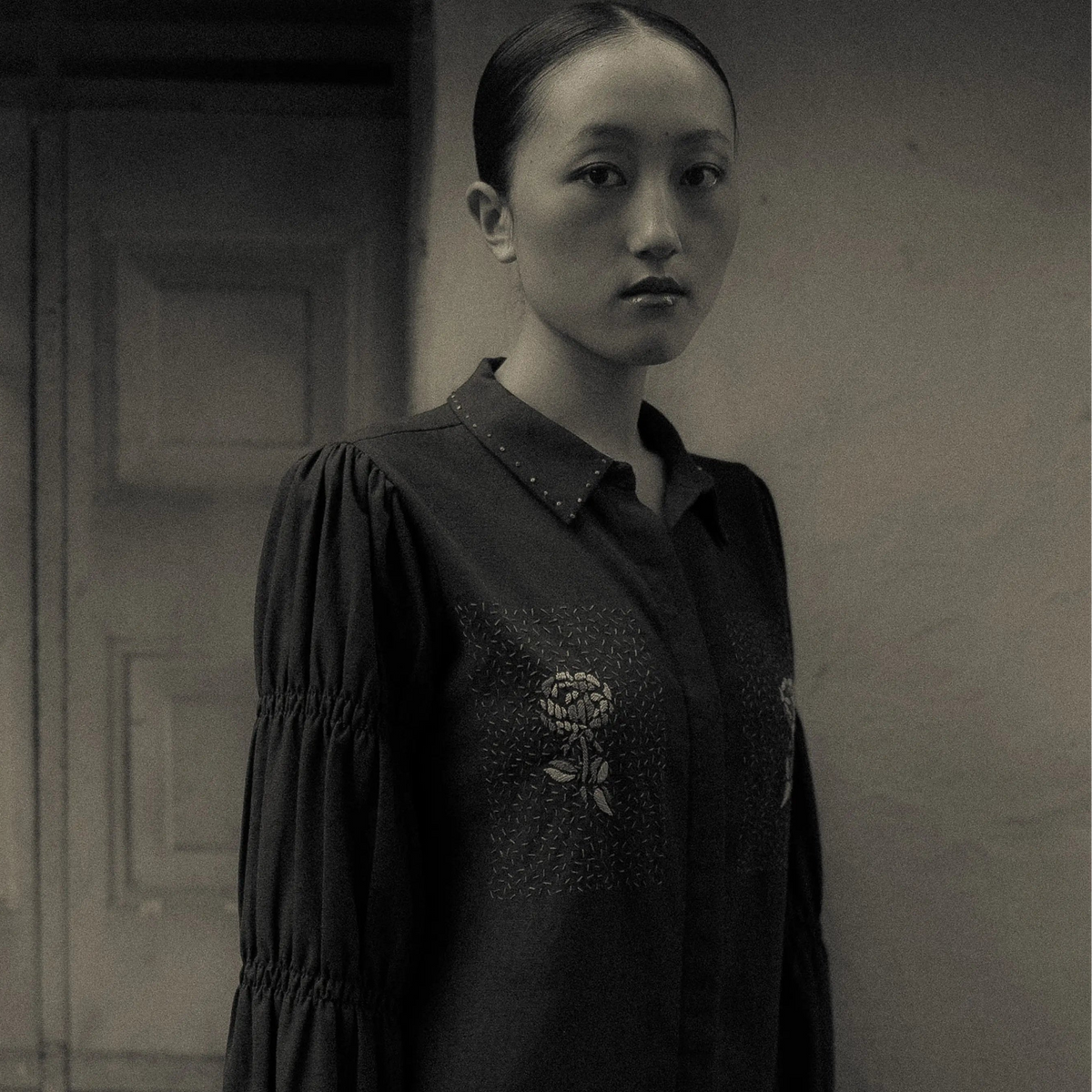
A garment can look modern without being made from polyester.
That sounds simple, but much of contemporary clothing has been built around synthetic fibres. Polyester alone accounted for 59% of global fibre production in 2025, with 82.5 million tonnes produced worldwide.
At URNAM, we have chosen a different starting point.
We begin with natural fabrics and then ask what modern form can come from them. Cotton, linen, handloom textiles and ethically sourced sheep wool each bring something different to a garment.
The choice is not about calling one fibre perfect and another one bad. Natural fabrics have their own environmental costs. Polyester also has useful qualities, including durability and easy care.
The question is what happens when we stop treating synthetic fabric as the default.
Why we stopped treating polyester as the default
Polyester became popular for good reasons. It is durable, relatively inexpensive and can be made into fabrics with many different finishes and performance qualities.
There is another side to that scale.
Polyester is a fossil-based synthetic fibre. Textile Exchange estimates that 88% of the polyester produced in 2025 came from virgin fossil-based sources.
Synthetic clothing also creates a different problem during use. Polyester and other synthetic textiles can release plastic microfibres when they are washed and worn. The European Environment Agency identifies synthetic textile washing as an important pathway for microplastic release.
That does not mean every polyester garment has the same impact. Fibre production, fabric construction, garment lifespan, washing and disposal all change the picture.
It does mean we have a reason to question the assumption that synthetic fibres belong in every wardrobe.
For URNAM, that question begins with the garment itself.
We want the fabric to have a relationship with the shape, the hand embroidery and the way the garment feels against the body. We work in small quantities, use natural and handloom fabrics, and bring craft into the design rather than adding it as an afterthought.
Avoiding polyester is therefore not only an environmental choice.
It is a design choice.
Why cotton still makes sense for modern clothing
Cotton has been part of Indian textile culture for centuries, but its relevance is not only historical.
It works because it is practical.
Cotton can feel soft against the skin, absorb moisture and work across light, structured and relaxed garments. That makes it particularly useful in clothing designed for warm climates.
The fibre itself, however, does not tell the whole story.
Cotton production can have very different environmental effects depending on farming methods, irrigation, climate, fertiliser use, processing and the source of the cotton. Calling every cotton garment sustainable simply because cotton is natural misses those differences.
That distinction matters to us.
We look at the fabric, but we also look at where it comes from and how it has been made.
Cotton gives us a quiet base for hand embroidery. Running stitches, Kantha, Aari work, appliqué and other techniques can sit directly within the fabric without making the garment feel overly ornate.
The result can still have a clean silhouette.
A cotton shirt can have a relaxed modern cut. A cotton dress can carry detailed embroidery without looking traditional. A cotton-linen piece can hold structure while remaining light enough for everyday wear.
The material does not decide the aesthetic on its own.
The cut does that too.
Why linen works so well with modern form
Linen has a texture that does not need much explanation.
You can see it.
You can feel it.
The natural irregularity of the surface gives even a simple silhouette some visual character. That is one reason linen works so naturally with the way we design at URNAM.
Linen comes from flax rather than cotton. Flax also has some useful agricultural characteristics. For example, European flax grown under the Masters of FLAX FIBRE system is described as requiring relatively low nitrogen inputs, while its certified cultivation uses dew retting without irrigation.
Those details do not make every linen fabric automatically sustainable. The full picture still includes processing, dyeing, transport, garment construction and how long the finished piece is used.
What linen gives us is a material with its own character.
It can hold a clean shirt shape while keeping the surface relaxed. It can create a fluid dress without making the garment look overly polished. It can also support embroidery without becoming visually heavy.
The wrinkles matter too.
Linen changes with wear. A crease does not necessarily mean the garment has lost its beauty. It can be part of how the fabric lives with the person wearing it.
For us, that feels closer to real clothing.
What makes handloom fabric different from ordinary fabric
Handloom is not a fibre.
It is a way of weaving.
A handloom can produce cotton, wool, silk and other yarns. What changes is the process, and that process can leave visible character in the finished cloth.
Small variations in texture, yarn and weave can make handloom fabric feel different from highly uniform mill-made cloth.
We do not see those variations as imperfections that need to disappear.
They can become part of the garment.
This is where Indian craft becomes more than a reference on a mood board.
A handloom fabric carries the work of the person who wove it. The value is not only in the finished surface. It is also in the skill, time and textile knowledge behind it.
That relationship becomes even more important when the garment is paired with hand embroidery.
The embroidery artist is not simply decorating a finished product. The embroidery becomes part of the garment's construction and visual language.
At URNAM, we want those two layers to work together.
The weave creates the base.
The silhouette creates the form.
The embroidery creates another layer of detail.
None of them needs to shout.
Why sheep wool can belong in contemporary Indian clothing
Wool is often associated with traditional winter clothing, but the fibre can do much more.
Sheep wool can create warmth, texture and structure while remaining a natural fibre. It can also be woven into fabrics with a quieter surface that works well with contemporary shapes.
Our interest in sheep wool comes from looking at material closer to its source.
We work with handwoven sheep wool sourced through relationships with weavers in Himachal Pradesh. That connection matters because ethical making is not only about the fibre itself.
It is also about knowing who made the textile.
A natural animal fibre still needs responsible sourcing. Questions around animal welfare, land management, processing and traceability remain relevant.
The same principle applies to cotton and linen.
Natural does not automatically mean ethical.
That is why we prefer to understand the journey behind a fabric rather than place a simple sustainability label on it.
Ethical making starts before the embroidery
A finished garment can hide a surprisingly long chain of work.
Someone grows or raises the raw material. Someone spins the fibre. Someone weaves or knits the fabric. Someone cuts the pieces. Someone constructs the garment. Someone embroiders it. Someone checks, finishes and packs it.
When we call a garment ethically made, we should be able to ask what happened along that chain.
Who made it?
Where was it made?
What did they receive for their work?
How much time went into it?
Was the production relationship temporary, or does the brand continue working with the same people?
Those questions matter to us because hand embroidery makes time visible.
A machine can repeat a stitch quickly. A person working by hand cannot.
That does not make every handmade product ethical by default. It simply means the person's time has to be treated as part of the value of the garment.
For URNAM, ethical making also means producing in smaller quantities, working with artisans and craftspeople over time, and avoiding the idea that more garments automatically mean a better business.
We would rather understand what goes into a piece before deciding how many pieces to make.
Natural does not mean perfect
Cotton has environmental costs.
Linen has environmental costs.
Wool has environmental costs.
Polyester has its own advantages and impacts.
There is no single fibre that solves fashion.
The more useful question is whether a brand understands those differences and makes deliberate choices.
At URNAM, we choose natural and handloom fabrics because they fit the kind of clothing we want to make. They feel good against the body, carry texture without excessive decoration, and allow Indian craft to sit comfortably inside modern silhouettes.
The result is clothing where material, craft and form belong to the same conversation.
For us, that is what natural fabrics and modern form mean.
Not a trend.
A way of making.